
-
Micro/Nanorobotics


Micro/nanorobotics studies small-scale machines and functional systems capable of operating in confined and delicate environments. These systems are important for applications such as biomedical intervention, single-cell manipulation, and microscale assembly, where precise motion, compliant interaction, and multifunctional integration are essential. A central challenge is that many existing microrobotic systems remain limited by planar geometries, simple actuation modes, and insufficient adaptability.
Our research addresses these challenges by developing 3D architected micro/nanosystems with programmable geometry, shape morphing, and integrated functionality. By combining microfabrication, three-dimensional transformation, and functional material design, we create microrobots capable of controlled locomotion, gripping, sensing, and interaction with cells and microscale objects.
Representative work:
1. J. Cui#*, T.-Y. Huang#*, Z. Luo, P. Testa, H. Gu, X.-Z. Chen, B. J. Nelson, and L. J. Heyderman, Nanomagnetic encoding of shape-morphing micromachines, Nature 575, 164 (2019).
2. Y. Zong, M. Xi, Y. Wang, G. Zeng, D. Hu, H. Hu, X. Hou, K. Nan, X. Chen, F. Xu, O. G. Schmidt, Y. Mei, and J. Cui*, Waveguide microactuators self‐rolled around an optical fiber taper, Adv. Mater. 37, 2418316 (2025).
3. Y. Wang, X. Li, C. Liu, Y. Wang, C. You, H. Zhu, Z. Zheng, Z. Zhang, G. Jiang, X. Dong, T. Cai, Z. Tian, Z. Di, G. Huang, X. Chen, E. Song, J. Cui*, and Y. Mei*, Terrestrial locomotion of microscopic robots enabled by 3D nanomembranes with nonreciprocal shape morphing, Proc. Natl. Acad. Sci. U.S.A. 122, e2500680122 (2025).
4. G. Zeng, H. Pan, M. A. Kurochkin, Y. Zong, S. Xiong, J. Yang, M. Xi, Y. Mei, Y. Mei, X. Chen*, and J. Cui*, In situ reprogrammable magnetic microrobots, ACS Materials Lett. 7, 3943 (2025).
-
3D Microelectronic Devices
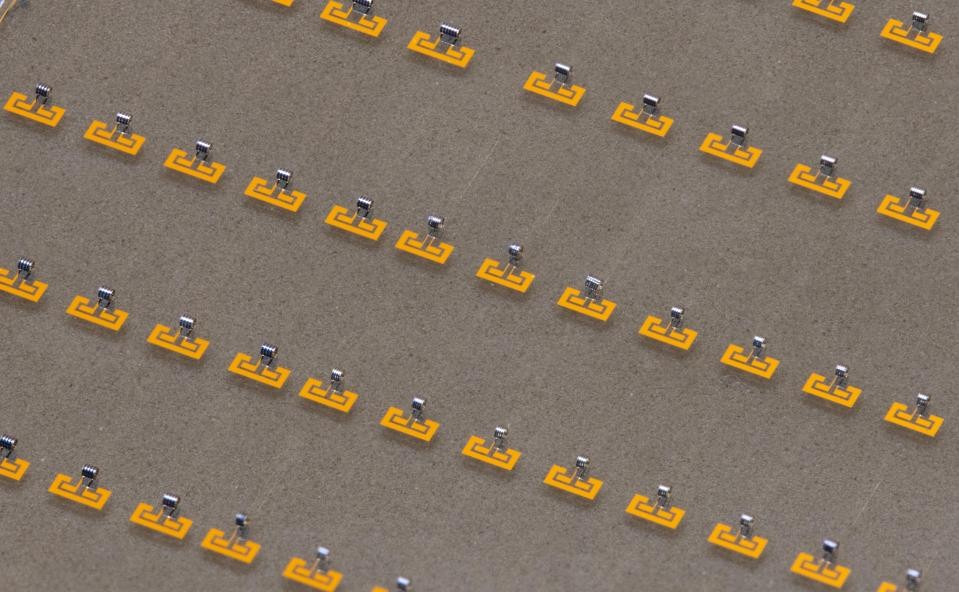
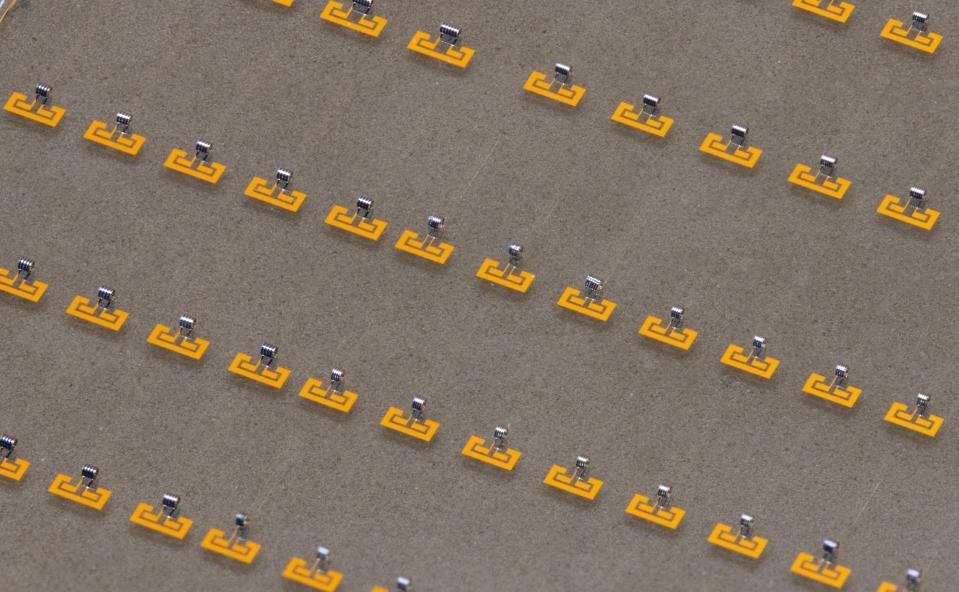
Three-dimensional microelectronic devices offer new opportunities beyond the limits of planar electronics. As integrated circuits demand higher density, improved performance, and more compact functional components, 3D architectures provide powerful routes toward enhanced space utilization and device functionality. The key challenge is to fabricate precise three-dimensional structures in ways that remain compatible with microfabrication while delivering clear electrical advantages.
Our work develops shape-transformable fabrication strategies for 3D microelectronic components whose geometry is directly linked to function. Through structural design and controlled three-dimensional assembly, we aim to build compact devices with enhanced electronic and electromagnetic performance for next-generation integrated circuits and related microsystems.
Representative work:
1. L. Chen#, Z. Qiao#, S. Liu#, J. Yang, Y. Wu, P. Liu, Z. Zheng, L. Zhang, Y. Hu, T. Wu, W. Huang, Y. Mei*, G. Huang*, and J. Cui*, High inductance density in CMOS-compatible magnetically integrated 3D microinductors for radio-frequency applications, Nat. Commun.16, 10072 (2025).
2. X. Dong, X. Li, J. Cui*, and Y. Mei*, Origami and kirigami on nanomembranes: Design, fabrication, and applications, Adv. Mater. e10883 (2025).
-
Metamaterials
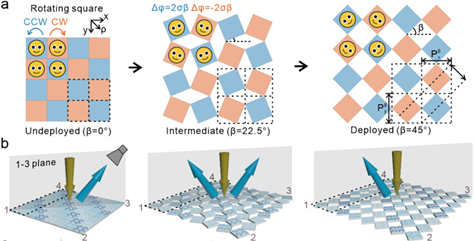
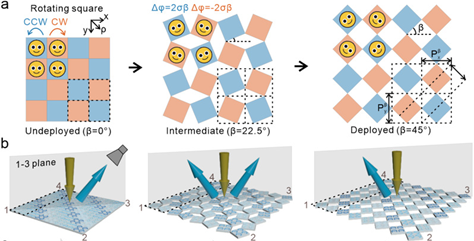
Metamaterials are architected systems whose properties arise primarily from designed structure rather than composition alone. They are important because they enable unusual and highly useful control of electromagnetic, optical, and mechanical responses. However, many metamaterials remain static after fabrication, limiting their adaptability and practical use in dynamic environments.
Our research explores reconfigurable and shape-morphing metamaterials whose properties can be actively tuned during operation. By integrating 3D architected structures, mechanical transformation, and functional materials, we develop programmable metamaterials for applications in integrated circuits, sensing, and adaptive physical systems.
Representative work:
1. G. Jiang#, Y. Wang#, Z. Zhang, W. Pan, Y. Chen, Y. Wang, X. Chen, E. Song, G. Huang, Q. He, S. Sun*, J. Cui*, L. Zhou, and Y. Mei, Abnormal beam steering with kirigami reconfigurable metasurfaces, Nat Commun. 16, 1660 (2025).
2. G. Jiang, Z. Zhang, Y. Wang, X. Li, Z. Zheng, Y. Mei, L. Zhou, S. Sun, and J. Cui*, Reconfigurable phase profile symmetry in kirigami metasurfaces, Adv. Opt. Mater. e03586 (2026).
